


Picture this in your plant: Improper fasteners holding together an air conditioning unit, a random drain hose leading to a floor drain or a pipe without the proper heat-resistant insulation and/or coatings.
It shouldn’t be too difficult to imagine — these are some of the examples of unauthorized temporary modifications once found at plants in the Utilities Service Alliance fleets.
That was then. It’s different now.
USA’s Engineering Core Peer Team (ECPT) recognized two years ago that during INPO plant evaluations, several plants were issued Areas for Improvement or Performance Deficiencies stemming from unauthorized temporary modifications.
It was a condition that the ECPT couldn’t live with. So it initiated a fleet-wide program to improve this area, which included USA peer support of plant walk downs to ensure a common fleet standard and sensitivity to what is an unauthorized modification.
The program is working: as of today no USA plants have received an AFI or PD in the latest round of INPO inspections.
“It was a good eye opener for all department personnel,” said Len Rajkowski, lead of the Engineering Core Peer Team and engineering director at PSEG. “[In the last INPO inspections] the INPO Team “Blue Card” walk downs couldn’t find an unauthorized / undocumented T-mod that was not already in the plant’s corrective action system. And that’s thanks to this endeavor.”
It is important to get rid of unauthorized t-mods, Rajkowski said, because they could potentially reduce the margin of safety in plants, result in adverse operational effects or cause plants to be outside of their license or design basis. (An example could be the impact non-insulated pipe has on Equipment Qualifications).
The ECPT understood that risk and wanted to improve the situation.
“The main problem was a lot of these things had been there for so long that we didn’t even recognize that they were there at all,” said the then-lead of the ECPT, James Thorson, manager of performance engineering at Fermi 2.
Thorson equated the phenomenon to plant signage: at your plant, you don’t read all the signage because you know what’s ahead. It is easy to gloss over.
“The solution we found was to bring in people that don’t know your plant, and they’ll say, ‘look at all this stuff, it doesn’t look right and doesn’t meet an industry standard,” he said. “It’s like the signage: When you are at a new plant, you read everything because you don’t know what is behind the next door.”
Rajkowski said the ECPT created a procedure and training on what to look for and sent one of its members and a subject matter expert to each plant. Those experts spent two days at one-unit plants and three days at two-unit plants conducting walk downs.
The visitors took hundreds of photographs and presented them to the site management. The site then mitigated the issue by: documenting the observations in the corrective action process; setting the priority for removal and/or mitigation; or determining whether configuration items identified needed to be controlled by a procedure or the temporary modification process.
“They identified things that the plants didn’t even consider a temporary modification,” he said. “Things like removing insulation and not putting it back on, or hoses running under doors.”
The fleet was rewarded for the hard work.
“It really paid off throughout 2013,” Rajkowski said of the latest round of evaluations. “It was a good effort.”
“And it really speaks to the importance of working together as a fleet. The biggest reason for our original issue was our blindness to our issues. By bringing in experts from around the fleet to each plant, we were able to tackle this issue as a team and mitigate the issue,” he said.
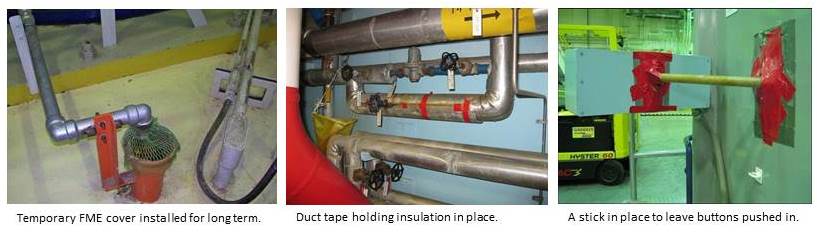
These are examples of unauthorized temporary modifications found at USA plants. Through the effort by the Engineering Core Peer Team, knowledge of this issue has been elevated and undocumented modifications have all but been eliminated in the fleet, utilizing the Corrective Action Process.